Showing posts with label Rathmines. Show all posts

Thursday, 19 November 2015

2016: Time to Honour Kathleen Lynn


Suffragist, labour activist and nationalist, Kathleen Florence Lynn lived most of her life in Rathmines, and has been shamefully forgotten in a city she served selflessly and tirelessly.
She was born in County Mayo in 1874, daughter of Church of Ireland Rector, Robert Lynn. Some of her education was received at Alexandra College, Dublin; she qualified with degrees in medicine, surgery and obstetrics from the Royal University in 1899. In 1909 she was made a Fellow of the Royal College of Surgeons.
During the Lock Out of 1913, she became involved in the relief efforts for workers and their families. This commitment to the welfare of Dublin’s poor became a driving force for the rest of her life.
Her activities brought her close to Countess Markievicz and James Connolly. She was appointed Chief Medical Officer with rank of the Captain of the Irish Citizen Army, and served in that position during the Easter Rising. Part of the City Hall Garrison, at the time they surrendered, it was Kathleen who was in command. Imprisoned after the Rising; following her release she became an active member of Sinn Féin. She was elected TD for Dublin County on the anti-treaty side in 1923. After failing to be re-elected in 1927, her involvement in politics diminished; she did remain active with the Rathmines urban district council until 1930.
Lynn lived and ran a practice at 9 Belgrave Road, Rathmines. Her commitment to Dublin’s poor was exemplified by her work at Saint Ultan's Hospital, which she founded, along with Madeleine ffrench-Mullen, in 1919 to care for impoverished mothers and infants. It was a pioneering initiative, the first infant hospital in Ireland.
She died on 13 September 1955, and was buried in Deans Grange Cemetery with full military honours.
Her sympathies with the Republican cause brought her into conflict with her family, her gender mitigated against her in her profession. In spite of all this, she persisted and is one of Ireland's great unsung heroines. Perhaps the new children’s hospital will be named after her; one way or the other, it is now time to honour Kathleen Lynn. 

Wednesday, 27 February 2013

Rathmines Public Library


By Rebecca Clancy

Rathmines Public Library


Rathmines public library was built in 1913 with the aid of funds from the Carnegie United Kingdom Trust. Andrew Carnegie was a Scottish/American industrialist who was responsible for allocating the funds. Andrew, who was born on November 25th 1835, was the man behind the expansion of the steel industry in America.

Carnegie was born in Dunfermline, Scotland where he lived for some years before emigrating in 1848 to the United States with his parents. Carnegie intentionally started out as a factory worker and landed his first job in a bobbin factory. Eventually he worked his way up and began working for a telegraph company. It was from there that he built Pittsburgh’s Carnegie Steel Company.

Rathmines Library in the early 20th Century
Carnegie, who is often referred to as the second richest man in history, earned most of his fortune in the steel industry. He invested most of his earnings in establishing schools, universities, libraries and museums. The majority of them were located in the United States, Canada, the United Kingdom and Ireland. One of his most famous buildings is Carnegie Hall in New York.

Although the building we know today as Rathmines Public Library was built in 1913, the library originally had two previous locations. It was initially located at number 53 Rathmines road. However it quickly became very popular and more space was needed to accommodate its customers.


Main Entrance
In the year 1899 it moved to 67 Rathmines Road where it stayed for 14 years before moving to the building we know and use today. At the time of construction, a competition was held to design the new library. Frederick Hicks won the competition and the firm of Bachelor and Hicks of Dublin were the architects awarded the design of the new building.

The library was built with the aid of £8,500 from the Carnegie grant and it opened its doors on the 24th October 1913. The overall design of the library was intended to blend in with the design of the Town Hall as much as possible and to act as ‘an ornament to the township’. Although the library and technical school are adjoining and part of the same building they have two separate entrances.


The library, as well as having a lending department where people could visit and borrow books, also had a special room where people could come to read the newspapers each day and a reference library where people could sit and read at their leisure.  Newspapers were expensive items in the early 1900’s and the newspaper room was extremely popular as people could look up the job pages and catch up on the latest news for free.

The beautiful library staircase
The library features a beautiful stained glass window which is located half way up the double staircase and was designed by William Morris, who was a famous English artist and designer. The library is also home to the only surviving plaque from the Princess cinema. The cinema was opened as the Rathmines Picture Palace on March 24th 1913 just several months before the opening of the library.

The library was used by various different community groups and clubs in the area. The Public Health Department held its clinics in the library. The Thomas Davis branch of the Gaelic League also held their meetings in the building as did the Rathmines chess club.

Tuesday, 19 February 2013

Swan Art: the ultimate form of expression


By Peter Feehan


Swan Art has not been a part of the Rathmines community for very long, but with its ever growing popularity among residents, it is slowly emerging as a social hub for artists both young and old.

The woman behind this club is Germaine Murphy, a former art teacher of 25 years at Alexandra College, before her retirement last June.

Not the type of person to sit idly-by, and realising she still had so much more to teach, she began Swan Art; a place for people of all ages to come and get in touch with their inner artist. Germaine offers classes to cater for all levels of ability.

There are beginner classes for adults as well as master classes for the more experienced painter. Germaine also provides sculpting classes once a week.

Since it opened in September 2012, its popularity has grown, cementing its place in the community. Students and participants have expressed a sense of safety in the studio, and it provides those availing of the classes the opportunity to meet people with similar interests.

According to Germaine, the response from the community has been immense, with people stopping by, looking for timetables, or even just to say what a wonderful thing they believe Swan Art to be.  

Monday
10am – 12pm: Adult Art Class
7pm – 9pm: Sculpting
Tuesday
4.30pm – 5.30pm: Primary School Students Art Class
7pm – 9pm: Adult Art Class
Wednesday
2pm – 4pm: Adult fine art classes
7pm – 9pm: An introduction to fine art print making
Thursday
10am – 12pm: Beginners adult fine art classes
6.30pm – 8.30pm: Adult fine art classes
Friday
10am – 12pm: Adult fine art classes
Saturday
11am – 12pm: Children (4 to 6 years old)
1pm – 2pm: Children (7 to 12 years old)
4pm – 6pm: Leaving Certificate students 

The Irish Hitchcock


By Peter Feehan


Irish Life
An autographed portrait of Rex Ingram
On 15 January 1892, in 58 Grosvenor Square, Rathmines, Kathleen Ingram gave birth to Reginald Ingram Montgomery Hitchcock. Reginald was educated at St. Columba’s College, near Rathfarnam, along with his brother Francis Clere Hitchcock

Reginald’s father was a Church of Ireland clergyman. His career with the Church of Ireland meant the family moved around quite a bit but they would eventually settle in Kinnitty, Co. Offaly, where his father was made rector.

From an early age, Ingram showed signs of a rebellious nature. One of his classmates once remarked that as a “rebel at heart he had a discomforting disdain for authority, and escapades brought him into close conflict with those responsible for discipline”. It is said he once challenged his schoolmaster to “see who was the better man” behind the gym.

Ingram’s mother died when he was fifteen years of age. This trauma, coupled with his failure to secure a place in Trinity College, and the lack of opportunities in Ireland led to his emigration to America in 1911.

American Dream
On the 25th June 1911 the RMS Baltic docked in New York along with the nineteen-year-old Hitchcock. Chasing his dreams, Reginald would never again return to Ireland. He enrolled in a sculpting course in Yale but he later left the course to pursue a career in film.

Fascinated by the new medium of silent film, he took up a job at a production company based in New York. This was the breakthrough into the industry that he needed. It first began with small, menial parts in films like ‘Beau Brummel’ (1913) and ‘The Artist’s Great Madonna’ (1913). He had a leading role in the 1914 short ‘The Witness to the Will’
Rex Ingram & Alice Terry

Never one to settle he moved to a larger production company called Vitagraph. After a short time Ingram moved once again, this time to Fox Film Corporation where he produced scripts and scenarios.

It was while at Fox that Reginald changed his name to Rex Ingram, in honour of his mother. A falling out with Fox executives led Rex to yet another move. It wasn’t long before he arrived at Universal Film Manufacturing Company.

At Universal Rex was finally given the chance to direct his first film. ‘The Symphony of Souls’ starring Robert Z Leonard and Ella Hall was released in 1914. But it wasn’t until his second film, ‘The Great Problem’ (1916), starring Violet Mersereau, that Ingram began to garner attention.

He would produce two more films in 1916, ‘Broken Fetters’ starring Violet Mersereau, and ‘The Chalice of Sorrow’. Rex had finally made it to the big-time, but it still didn’t stop the “rebel” from falling foul of company executives, forcing another move to Paralta Plays Inc.

1917 - 1932
In 1917, Rex enlisted in the Royal Canadian Flying Corps. World War One was reaching its conclusion and he never saw any real action. When he arrived back from service, he found himself having to call in favours to restart his career. He also married his first wife in 1917, actress Doris Pawn.

In 1919 he directed ‘The Day She Paid’ for Universal, and then ‘Under Crimson Skies’ in 1920 before moving production company again, this time to Metro Studios. It was here that he would be introduced to June Mathis. Mathis and Ingram would go on to make four films together; ‘Hearts are Trump’ (1920), ‘The Four Horsemen of the Apocalypse’ (1921), ‘The Conquering Power’ (1921), and ‘Turn to the Right’ (1922).

With his first marriage ending in divorce in 1920, it was rumoured that June Mathis and Rex Ingram were romantically involved, but Ingram would marry Alice Terry in 1921, with who he remained for the rest of hi life. Alice Terry was the lead actress in ‘The Four Horseman of the Apocalypse’.

In 1925, Ingram and fellow director, Fred Niblo, co-directed the hugely successful ‘Ben-Hur’. After the completion of ‘Ben-Hur, Ingram and his wife, moved to the French Riviera. They set up their own studio in the city of Nice and made several more silent films together.

Ingram would only ever direct one talking film, Baroud for Gaumont British Pictures in Morocco. The film was a commercial failure and he left the film business. He would never direct again.

Rex Ingram with artist Henri Matisse
Life after film
Rex returned to Los Angeles to concentrate on his sculpting and writing. He converted to Islam in 1933 after becoming infatuated with the faith over several years. He would go on to publish two books; The Legion Advances (1934), a gorey story about the French foreign legion, and Mars in the House of Death (1939), a story about a bullfighter and his doomed love.

Rex Ingram died of a cerebral haemorrhage on 21 July 1950, aged just 58.

Recognition

 In 1949 the Directors Guild of America awarded Ingram an honorary life membership. For his contribution to the film industry he was awarded a star on the Hollywood walk-of-fame, located at 1651 Vine Street.

Monday, 4 February 2013

Mary Immaculate, Refuge for Sinners

by Louise Buckley


Beginnings of the parish

The parish of Rathmines first came into existence on December 12, 1823. It was officially constituted by Daniel Murray, the Archbishop of Dublin at the time. Archbishop Murray appointed Fr. William Stafford as the first parish priest.

In 1824, two acres of land were purchased from the Earl of Meath. Lord Brabazon, who was heir to the Earldom of Meath, laid the foundation stone for the new church that same year.

The Gothic style church took five years to complete and cost almost £5,000. Archbishop Murray solemnly consecrated the church under the protection of St. Mary and St. Peter on August 15, 1830.

Expansion
By the middle of the 19th Century the Catholic population of Dublin had greatly increased, and this growth necessitated the enlargement of the church in Rathmines.

Fr. Gentili, who was a visiting missionary priest of the Order of Charity, proposed building a new church in a similar style to churches he had observed on his travels in Italy.
At a meeting in December 1848, it was decided that a new church was to be built to the Byzantine model in the form of a Greek cross. This would be the first such construction in the Archdiocese of Dublin since Catholic Emancipation.

On August 18, 1850, the foundation stone of the new church was laid by Archbishop Murray. Construction of the new church was completed in 1856. By this time Dublin had a new archbishop: Fr. Paul Cullen.
It was Archbishop Cullen who blessed the refurbished church during a lavish ceremony attended by 16 bishops and almost two hundred priests. It was also at this time that the word ‘Immaculate’ was inserted into the title of the church.

In 1854, Archbishop Cullen had been in Rome for the solemn declaration of the Immaculate Conception as a dogma of the Catholic faith. This inspired him to write to the parish priest, Fr Meagher, and instruct him to insert the word ‘Immaculate’ into the title.

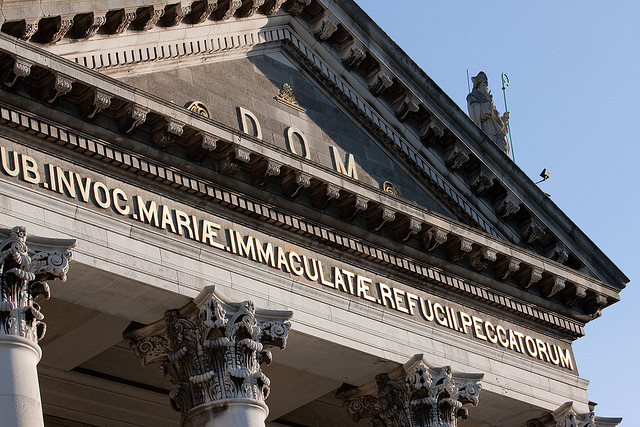
By 1881 a magnificent portico had been built at the entrance to the church. It was supported by the four massive pillars still standing today.
To crown the beautiful new entrance, Fr Meagher had the statue of ‘Our Lady of Refuge’ removed from the inside of the church and mounted on top of the portico. The impressive statue is flanked on either side by the statues of Saint Laurence O’Toole and Saint Patrick.

The letters D O M were then placed at the top of the portico just below the statue of Mary. They stand for Deo Optimo Maximo. Underneath this are the words ‘Sub Innov. Mariae - Immaculatae Refugi Peccatorum’ – ‘Dedicated to God the Most High under the invocation of Mary Immaculate, Refuge of Sinners’.

The tragic fire of 1920

On January 26, 1920, the sacristan arrived to open the church for the 7am Mass to discover that the switch panel was on fire. He raised the alarm but the whole front of the altar was already engulfed in flames. The fire spread quickly along the electricity wires and Canon Fricker was forced to stand and watch helplessly as the church was devoured by flames.

As the raging fire consumed the church, the large dome came crashing down, making a deafening sound that was heard for miles around. The only parts to escape damage were the shrine of Our Lady of Perpetual Succour and the sacristy.

Two beautiful stain glass windows, valued at £1,000, survived the fire, but they were heavily damaged by gusts of wind blowing through the shell of the church the next day.

A week later a public meeting was held in the Mansion House to discuss the rebuilding of the church. The Lord Mayor presided and those present included the Archbishop, the Lord Chief Justice and members of Dublin Corporation.

 The architect, R.H. Byrne, was subsequently commissioned with the task of rebuilding the Church. In a short time the debris was removed and a temporary roof was erected. The walls, although badly damaged, were found to be structurally sound but the interior required considerable refurbishment.

The façade was relatively intact. The cost of repairs was estimated at £35,000 but ultimately came to £55,000. The outstanding feature of the reconstructed church was the large copper dome. It replaced the previous one, which was completely destroyed in the fire.

This new dome was built in Glasgow and had been destined for a Russian orthodox church in St. Petersburg. However, the political and social due to the Bolshevik revolution in 1917 saw it diverted to Dublin.
The church has changed very little since its reconstruction in the 1920’s, while its beautiful copper dome can be seen from afar. 

Monday, 28 January 2013

InRathmines Street Style


InRathmines Street Style
By Rebecca Clancy
Welcome to InRathmines Street Style. Each week our reporter Rebecca Clancy will be going out on the streets of Rathmines to find the latest fashion and clothing trends. Keep an eye out for her.

Charlie Mullen - Student
Wearing:
Adidas Top
Penny’s Coat
Topman Jeans


Molly Woods – Student
Wearing:
Topshop Leather Jacket
Topshop T-shirt
Penny’s Skirt


Thursday, 10 January 2013

The Death of Francis Sheehy Skeffington


The Death of Francis Sheehy Skeffington

by Barry McGuinness

Francis Sheehy Skeffington
As a sizable suburb of Dublin, Rathmines has a deep seated place in both the cultural and political history of the city. Encompassing both contexts is the death of the famous writer, pacifist, and suffragist, Francis Sheehy Skeffington. He was killed during the Easter Rising of 1916 at Portobello Army Barracks, not far from his home in Grosvenor Square, Rathmines. 

Originally from County Cavan, he was the only son of Joseph Skeffington and Rose Magorian. Francis Skeffington was educated in Dublin by the Jesuits, and then enrolled in University College Dublin. It was at UCD he befriended James Joyce, Oliver St. John Gogarthy, Thomas Kettle, and his future wife Hanna Sheehy.

Francis Skeffington was a well known figure in UCD as he was part of the debating society in the college. He also organized petitions for women to be admitted into the college on the same basis as men. Skeffington was also a pacifist, feminist and socialist. His early life after college saw him involved in many political movements in Ireland.

It was in 1903 that he married Hanna Sheehy. She was the daughter of David Sheehy,a Parliamentarian and land agrarian. As a show of solidarity to the feminist movement he took the name Sheehy Skeffington after their marriage. His wife was the main bread winner in the home as she held a full time teaching position while he worked as a freelance journalist.

Hanna Sheehy, whom he married in 1903
The couple were an integral part of the Irish women’s suffrage movement and also lobbied for women’s rights in Britain. In 1908, Skeffington and Hanna helped establish the Irish Women’s Franchise League and also gave speeches on their behalf during the 1913 Strike and Lockout in Dublin.

It was during this period he helped to set up the Irish Citizens Army with James Connolly and Jack White. He became vice chairman of the ICA for a time, but left the group when he became aware of James Connolly's intention to align the group with the Irish Republican Brotherhood.

In 1915, Skeffington made a famous speech from the dock after he had been arrested for making anti recruitment statements for the First World War. The speech was about the rights to the freedom of speech, and the introduction was written by George Bernard Shaw.

In 1916, activities surrounding the Easter Rising would be fatal for Skeffington, his wife, and young son, Owen. As fighting took place across the city on the night of Tuesday the April 25, 1916, Skeffington tried to organise groups to prevent looting taking place throughout the city. He was arrested for no obvious reason, but was later detained because he admitted to being a sympathiser of the insurgents behind the Easter Rising.

Later that night he was sent out as a hostage with a raiding party from the Royal Irish Rifles from Rathmines to Portobello. Throughout the raid his hands were tied behind his back. The raiding party was trying to find rebels or sympathizers to the rebellion. This task had been instructed by Captain J.C. Bowen Colthurst. On the same night, three other men were arrested by the raiding party; two journalists and a Sinn Fein politician. The next morning, Sheehy Skeffington and the two journalists, Thomas Dickson and Patrick MacIntyre were shot without trial by firing squad.

Minister for Justice Alan Shatter laying a wreath where he was executed
They were buried within the grounds of Portobello Barracks. In an effort to cover up this injustice, Bowen Colthurst raided the Skeffington home in Rathgar to try and find evidence of his participation in the rising, but none was discovered. Bowen Colthurst would later be imprisoned in Broad Moor insane asylum. He was released 19 months later and retired to Canada on a full pension.

Skeffington’s body was given back to the family and he was buried in Glasnevin Cemetery on 8thof May 1916. There is a plaque in the grounds of Cathal Brugha Barracks to honour his life and death.


Wednesday, 12 December 2012

Timothy Coughlin 1906 - 1928


Timothy Coughlin 1906 – 1928 

by Lorcan Allen


To this day the life and death of Timothy Coughlin is still a hotly disputed subject. He was born in Dublin in 1906 and lived in Inchicore with his parents. He was the second eldest of nine children. Only in his teens, Coughlin quickly joined the I RA during the War of Independence (1919-1921). He fought against the black and tans up until the ceasefire but was disappointed with the outcome of peace talks between Britain and Ireland. He rejected the Anglo-Irish Treaty (1922)and continued to fight with the ‘irregulars’, the IRA during the Irish Civil War (1922-1923).

As a known member of the Dublin Brigade of the IRA, Coughlin was arrested in the early days of the Civil War and spent most of it interred in prison. While there,Coughlin formed a secret vengeance group with fellow irregulars, Archie Doyle and Bill Gannon. The three conspirators vowed to take vengeance against the‘free staters’ once they were released.

Most of these conspiracy groupings were broken up by the IRA after the Civil War when it was re-organised under new leadership, but Coughlin, Doyle and Gannon persisted. On July 10 1927, the three men ambushed and killed the then Minister for Justice, Kevin O’Higgins.
Kevin O'Higgins leaving Dublin Castle with Michael Collins

O’Higgins was on his way to mass in Blackrock, Co. Dublin, when he was shot down by the three conspirators. O’Higgins resembled all that the anti-treaty hated most about the new Free State, as he had ordered the executions of seventy seven anti-treaty soldiers during the Civil War. Kevin O’Higgins had always openly accepted responsibility for their deaths and never expressed any remorse.

His death shocked the Irish public at the time. As such a high ranking member of the fledgling government, it was a huge breach of security for him to be openly gunned down on his way to mass.

However,Coughlin along with Doyle and Gannon managed to escape and remained in hiding for the next six months. On January 28 1928, timothy Coughlin was killed in very controversial and unclear circumstances.

What is known is that Coughlin and another IRA volunteer, possibly Archie Doyle, were on Dartry Road near Rathmines in Dublin. They were hiding opposite ‘Woodpark Lodge’. At the time it was the home of Sean Harling. Harling himself was an IRA volunteer but he had turned government informer.
The remains of Kevin O'Higgins being removed from the Mansion House

What comes next is the most disputed side of the story. Harling claims that he noticed Coughlin and Doyle, and fled as they began to shoot at him. He says that as he fled he fired his pistol in self-defence. Upon later returning to the house he discovered the body of Timothy Coughlin lying dead in the road.

Later a Tribunal was set up to investigate the incident. His version of the story was accepted by them and he was not charged. However, the IRA at the time claimed,as many still do today, that Coughlin was in fact set up and ambushed. They believed that he was set up for an execution for the murder he played a hand in the previous year.

This version of the story was supported by the outcome of Dr Wilfred Lane’s autopsy. Dr Lane found that Coughlin had died because of a bullet which had entered his head from behind. Dr Lane also suggested that a cigarette butt was still in Coughlin’s mouth which may have meant he was caught unawares.

The IRA claimed that Coughlin and Doyle were only at Woodpark Lodge to carry out preliminary surveillance only and not to attack Mr Harling.

To this day the true events of what happened on Dartry Road are not known nor will they ever be.

Tuesday, 4 December 2012

Mamie Cadden: Backstreet Abortionist


The Story of Mamie Cadden
by Justin Kelly

Born in the US, and one time resident of Rathmines, Mamie Cadden was a midwife, abortionist, and convicted murderer. Her story is a tragic tale of cruelty, malice, and backstreet mystery in Dublin City.

In 1891, Mary Anne “Mamie” Cadden was born to Irish parents from Mayo in Scranton, Pennsylvania. At the age of four, Mamie and her family returned to Ireland, where her father had inherited his family’s farm. She would remain in Ireland for the rest of her life.

In 1925, Mamie moved to Dublin to pursue her education as a midwife at the National Maternity Hospital, Holles Street. It was in 1931, as a qualified midwife, Cadden bought a property in Rathmines, Dublin, and commenced her own maternity nursing home. 

At that time, such practices were commonplace, with midwives acting independently from both the nursing and medical professions. It was here that her criminal activity would surface for the first time.

Within her Rathmines nursing home, she would deliver babies, and also pass on unwanted infants to foster families. As well as her normal practice, Mamie then started to perform abortions, which were illegal, and remain so to this day. Her activities could not be advertised, but word continued to spread, and women regularly sought her services.

In 1939, she was sentenced to carry out a year of hard labour at Mountjoy Prison, when it was discovered she had abandoned a new-born baby on the side of a road in Meath. She then had to sell her Rathmines nursing home in order to pay legal fees. From this point on, her actions would take an even more sinister and disturbing turn.

Following her time in prison, Cadden continued with her illegal activities, but this time in rented premises, because she could no longer operate as a legitimate midwife, having been struck off. Just six years after her first conviction, Cadden came before the law once again, when a pregnant woman claimed Cadden had inserted the laminaria tents which were found in her cervix.

Laminaria tents are rods which are inserted into a woman’s cervix to induce labour, and were commonly used to carry out abortions. Cadden refuted the claim, but under the Offences against the Person Act, 1861, she was convicted of procuring an abortion, and sentenced to five years in Mountjoy Prison.

This second term in prison did little to dissuade Mamie Cadden from continuing with her criminal behaviour. Upon her release, she resumed her practice in Hume Street, near St. Stephen’s Green in Dublin. She was still well known enough in Dublin to have women seek her out, even when she was operating out of a one room flat.

In 1951, when one of these women died under her care, she callously put her body outside in the street. Not enough evidence could be found to link Cadden with the woman’s death, and it was all of five years later when Cadden's activities were finally brought to an end.

In 1956, a client of Mamie Cadden, Helen O’Reilly died during a procedure, and yet again Cadden callously dumped her body into the street behind her flat. When Helen O’Reilly’s body was found, Mamie Cadden was arrested and put on trial for her murder. She was convicted, and sentenced to death by hanging, but this was later revised to life imprisonment.

Once her sentence began, Cadden's mental state was examined closely, before she was declared insane, and subsequently transferred to the Criminal Lunatic Asylum in Dundrum. Just three years into her life term there, in 1959, Mamie Cadden died from a heart attack. Her story is one of immense tragedy, and has been recounted many times, including on RTÉ’s documentary series, Scannal and Thou Shalt Not Kill.